

You’ll get conflicting advice about where your puppy should sleep at night.
Examples include:
- in a crate in the kitchen
- outside in a kennel
- wherever they like
- in your bed
The information you’re given will not be suitable for EVERYONE. So, don’t feel pressured into following it.
However, I do recommend sleeping close to your puppy for the first few nights.
This will help them to feel safe, to trust you and settle more easily into their new home.
In this blog post we’ll define where puppies should sleep at night, share 5 examples, discuss where your puppy should sleep for the first few nights and provide you with a 4 step plan for the first 7 nights.
Please note: There are affiliate links in this post. If you click a link and make a purchase I may receive a small commission at no extra cost to you. I only give recommendations for items I feel will truly benefit my audience. Thanks for supporting our blog!
If you prefer to consume content by watching and listening, please click on the video below. Otherwise, scroll down to read the full article.
Where should puppies sleep at night?
You and your puppy are individuals.
You’ll need to consider your environment and the needs of you and your puppy.
Therefore, I can’t give you an answer.
The only person who can make this decision is you.
I’ve given you 5 examples below and posed some questions to guide you.
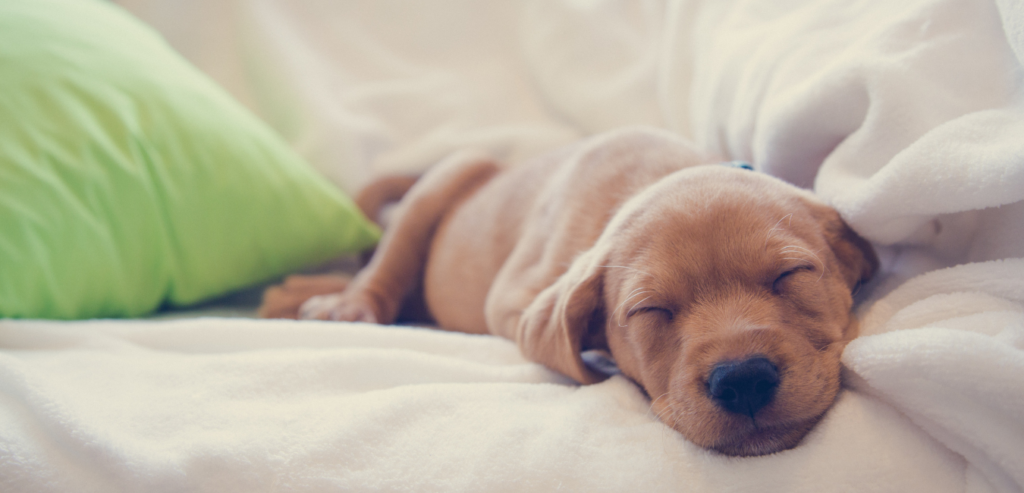
5 examples of where your puppy should sleep at night
1. A safe and secure environment
Are there any loose cables? Toxic chemicals, such as slug pellets or cleaning products stored in low level cupboards? Tools, nails, or glue laying around?
If so, this is not a safe space for your puppy to sleep. You can puppy proof the area, opt for a crate or go for a safer option.
Can people look inside the room from the street? Is the door sturdy and locked?
With a rise in dog thefts recently, my advice is to consider security very carefully.
“In March, DogLost, a UK charity that helps victims of dog theft, recorded a 170% increase in the crime, from 172 dogs reported stolen in 2019 to 465 in 2020” (The Guardian).
Can you hear your puppy if they bark or whine?
A baby monitor is a good option if you’re worried about not hearing your puppy. You can also buy cameras so you can keep an eye on your pup and check they’re fast asleep. I recommend this 2 pack security camera by Littlelf.
2. A quiet room that’s conductive to sleep
Do you have older children who stay up late? Or a baby who wakes in the night?
Is your boiler noisy when it starts up at 5am?
Does your neighbour set off to work early in the morning?
Could the rain or sunlight wake your puppy up?
Is it too cold? Too warm?
Consider all these questions because overtired puppies turn into bitey puppies who can’t think straight. And lack of sleep for humans is, in my opinion, torture!
3. An area with enough space
Will there be room for your puppy to stretch out once their fully grown?
Do you have a place for a water bowl?
Will a dog bed be in your way when you’re in a rush to get ready for work?
It’s much easier to think longer term than make changes later down the line.
4. A place where you’ll sleep well
Will you be disturbed by your puppy moving? Snoring? A nudge when they think it’s time to get up?
Or will you sleep better with your puppy close by?
You need a good night’s sleep too!
5. Where you’re happy for your puppy to sleep
Will you need to constantly clean the space? Will there be a doggy smell?
Do you have a new carpet or sofa?
These things might not bother you in the slightest and that’s cool. But if they do, choose a room where you can shut the door or a crate.

Where should puppies sleep for the first few nights?
The first few nights are going to be difficult for you and your puppy.
Just like us, puppies don’t sleep well in new places. They’re away from Mum and their litter mates. They’re in a new environment with new people.
As their guardian, you need to help your puppy to feel safe by sleeping close by.
Feeling safe is extremely important to dogs. And there’s a difference between being safe and feeling safe.
I recommend using a crate. Not just for the first few nights, but months.
You’ll find 3 different types of crates and recommended products to make it cosy for your puppy in this blog article.
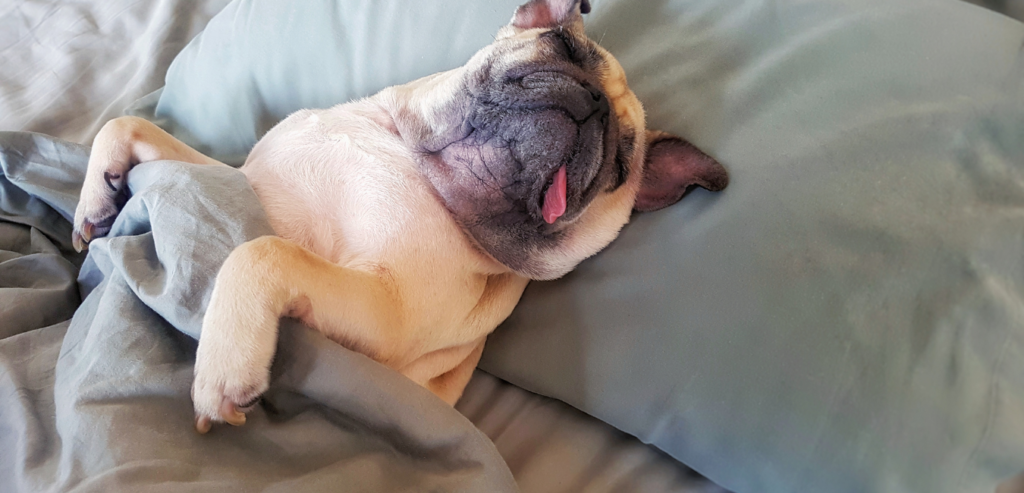
4 step plan for the first 7 nights
Progress through this plan at your puppy’s pace. It should be flexible. Don’t be afraid to move back a stage if your puppy is struggling.
Step 1
Nights 1 – 3
Sleep next to your puppy. This will help them feel safe and to trust you. Reassure them and take them outdoors for toileting as soon as they wake up.
Depending on your set up:
- your puppy sleeps upstairs next to your bed
- or you move downstairs and sleep next to your puppy
Step 2
Nights 4 – 5
Increase the distance between you and your puppy. But remain in the same room.
Continue to reassure your puppy and take them outdoors for toileting. Make sure loo breaks are boring and you bring your puppy straight back to bed.
Step 3
Night 6
Sleep in the next room or move your puppy’s crate outside of your bedroom.
You’ll hear your puppy if they wake. You need to be available, but not immediately.
Step 4
Night 7
Sleep back in your own bed or move your puppy’s crate into the room where you’d like them to sleep.
ZZZZZZZZZ
I hope this blog article has helped you to decide where your puppy should sleep at night. And you have a 4 step plan for your puppy’s first 7 nights in their new home.
Let me know in the comments section below if this blog post has helped you! I’d love to know.
You might also like my FREE Puppy Start Right Workshop, where we share a video tutorial on how to teach your puppy to LOVE their safe space (crate / pen).
Pop your details in below to get instant access and start teaching your pup today!

If you liked this article, please share it! And check out the related articles below.
Happy training!
Lindsay xx


0 Comments